


Online Master of Legal Studies
American University’s online Master of Legal Studies (MLS) program empowers nonlawyer professionals to leverage their legal fluency in a variety of industries. Our rigorous, multidisciplinary curriculum taught by AU’s experienced faculty blends legal, business, and international relations courses to provide a dynamic online learning experience.
Jump to:
Why Earn an MLS?
Curriculum
Faculty
Admissions
Tuition
Student Experience
Careers
FAQs
Why Earn a Master of Legal Studies Online?
Professionals in regulated or law-adjacent roles make decisions that can affect employees, customers, operations, and public trust. Earning a Master of Legal Studies online can help you spot legal issues earlier, frame more precise questions, and translate complex requirements into practical policies and procedures, all while continuing to work.
Online legal studies programs can serve professionals across many fields. AU’s online MLS program — sometimes referred to in the legal field as a Master of Studies in Law (MSL degree) — offers six specialization options and applied coursework in legal research, compliance drafting, negotiation, contracts, data privacy, governance and regulation. You can build knowledge relevant to business, government, health care, human resources, technology, social work, and other regulated settings.
As a student, you’ll be able to apply your learning across regulated workplaces and strengthen your practical skills like:
- Reading statutes, regulations, contracts, and legal decisions with confidence.
- Drafting clearer policies, procedures, codes of conduct, and communications for legal review.
- Identifying compliance and organizational risks before they become larger operational problems.
- Collaborating more effectively with attorneys, executives, regulators, and cross-functional teams.
- Evaluating the legal, ethical, and regulatory implications of emerging technologies and AI.
American University Washington College of Law also brings nationally recognized specialty expertise to the program. The current U.S. News rankings below apply to the law school’s specialty programs, not to the online MLS itself or to graduate outcomes.
Jump to:
Why Earn an MLS?
Curriculum
Faculty
Admissions
Tuition
Student Experience
Careers
FAQs
30-Credit MLS Curriculum and Specializations
American University’s 30-credit Master of Legal Studies (MLS) combines 12 credits of general degree requirements with 18 credits of specialization and elective coursework. Similar non-JD graduate credentials may be described as a Master of Studies in Law, or MSL degree, but American University’s official degree name is Master of Legal Studies.
Your course load can reflect your professional and personal responsibilities. Students may enroll full time or part time, and the accelerated full-time option can be completed in as few as 12 months. A full-time schedule prioritizes faster completion, while part-time enrollment distributes the curriculum across additional terms. An enrollment specialist can help you plan around live classes, course availability and specialization requirements.
CURRICULUM STRUCTURE
| Curriculum Component | Credits | Purpose |
|---|---|---|
General Degree Requirements | 12 | Build a foundation in courts, regulation, compliance drafting, negotiation and the required 1.5-creditimmersion |
Specialization and Elective Coursework | 8 | Develop focused knowledge and customize the program. The required-course and elective split varies by specialization |

Foundational Courses
Build a shared legal foundation through the following general MLS degree courses:
- Introduction to Courts and Law
- Introduction to Regulation and Compliance
- Drafting for Compliance Professionals
- Negotiation and Communication
Featured MLS Electives
Select electives that support your role, industry and specialization. Elective options include:
- Contract Drafting
- Criminal Justice
- Government Contracting
- Health Care Law and Compliance
- Cyber Law
- Human Resources Compliance
Featured Business Courses
Approved business courses from AU’s Kogod School of Business can connect legal analysis to organizational strategy and operations. Featured business course options include:
- Business Law, Ethics, and Governance
- Management of Information Systems
- Cybersecurity Governance
- Database and Big Data
- Business Insights Through Analytics
Featured International Relations Courses
Selected international relations courses from AU’s School of International Service can broaden your understanding of negotiation, communication and global institutions. Featured international relations course options include:
- Intercultural Communication
- International Negotiation
- Understanding Global Economics and Markets
- Global Economic Governance and Organizations
Online MLS Specializations
Tailor your Master of Legal Studies — sometimes referred to in higher education as an MSL degree — by choosing from six career-focused specialization options:

General MLS
Develop a broad working knowledge of the U.S. legal system, compliance, and applied legal topics. This flexible option can support roles that span several regulatory or organizational functions.

Business
Examine how law and regulation shape contracts, transactions, governance, finance, and business decisions. Completing the Business specialization also adds a Business certificate to your MLS.

Health Care Compliance
Study health care law, fraud and abuse regulation, information privacy, data security, and compliance-program design. The specialization pairs the MLS with a Health Care Compliance certificate.
View the Health Care Compliance Requirements
Qualified students may pursue an additional Health Care Compliance Certificate accredited by the Compliance Certification Board and become eligible to sit for designated CCB certification examinations within 12 months of completing the MLS. Current CCB eligibility and examination requirements apply.

Technology
Apply legal principles to information systems, data practices, electronic discovery, privacy and technology governance. Graduates of this option receive a Technology certificate in addition to the MLS.

Cybersecurity
Focus on cyberlaw, data privacy, security risk, and governance within rapidly changing digital environments. This specialization includes a Cybersecurity certificate in addition to the MLS.

U.S. Legislation
Analyze legislative processes, public-policy ethics, and the work of state and local governments. Completing this specialization awards you both the MLS and a U.S. Legislation certificate.
View the full Online MLS Curriculum for current course descriptions, credits and specialization requirements.
Required In-Person Immersion
As part of the 30-credit program, every student attends one required, 1.5-credit immersion on the American University’s Washington, D.C. campus. During the three-day experience, students practice presentation and negotiation skills through simulations, collaborate on group assignments, connect with classmates and instructors, and hear from professionals working in law and business. Students are responsible for the immersion tuition, program fee, travel, and lodging. Explore the Immersion Experience.
Jump to:
Why Earn an MLS?
Curriculum
Faculty
Admissions
Tuition
Student Experience
Careers
FAQs
Faculty Spotlight
Learn from faculty whose scholarship and professional experience connect legal doctrine to the issues covered throughout the online Master of Legal Studies curriculum.

Daniele Schiffman
Adjunct Professor Daniele Schiffman has taught in WCL’s Master of Legal Studies program for a decade, including Introduction to Regulation and Compliance and Drafting for Compliance Professionals. As General Counsel and Chief Compliance Officer of Indo-MIM Inc., she brings corporate legal and regulatory experience into discussions on how compliance challenges develop and how professionals can address them.

Ryan E. Norman
Adjunct Professor Ryan E. Norman is a career prosecutor and trial attorney with the U.S. Department of Justice. Drawing on experience at the Manhattan District Attorney’s Office and U.S. Attorney’s Office for the District of Columbia, he brings practical insight into courts, criminal law and legal decision-making to Introduction to Courts and Law.

Gordon-Andrew Fletcher
Adjunct Professor Gordon-Andrew Fletcher combines experience in housing policy, legislative affairs and community leadership. As Manager of the Rental Conversion and Sales Division at the DC Department of Housing and Community Development, he leads work involving rental housing, compliance systems and tenant protections. His AU courses use legislation and applied policy problems to show how law moves from analysis to implementation.
Jump to:
Why Earn an MLS?
Curriculum
Faculty
Admissions
Tuition
Student Experience
Careers
FAQs

Admissions Requirements and Deadlines
Applicants need a bachelor’s degree from an accredited college or university. The online MLS does not require GRE or LSAT scores. The admissions team reviews each applicant’s academic record, professional experience, goals, and required materials.
Submit the following application materials:
- A completed online application
- A nonrefundable $55 application fee
- A current résumé or CV
- Official transcripts from all colleges and universities attended
- Two letters of recommendation
- A statement of purpose of no more than 500 words
- English-language proficiency documentation if required for your international applicant status
Cohorts begin in January, August, and October.
Review the current Application Requirements and Deadlines before you submit because dates and requirements may change.
Tuition and Scholarship Guarantee
Tuition for the October 2026, January 2027, and April 2027 cohorts is $2,580 per credit. At 30 credits, estimated base tuition is $77,400 before scholarships, fees, and other expenses. American University reviews tuition annually, so use the current tuition page as the source of truth.
TUITION AND SCHOLARSHIP
Tuition Per Credit | $2,580 |
Program Credits | 30 |
Estimated Base Tuition | $77,400 before scholarships and fees |
Guaranteed Scholarship | $15,000 for qualified applicants to the October 2026 and January 2027 cohorts |
Additional Costs | Immersion fee plus student-paid travel, lodging, meals, local transportation, and other program expenses |
Qualified applicants to the listed cohorts are guaranteed a $15,000 scholarship upon acceptance and enrollment. Eligibility terms, tuition, and fees can change. Review the current Tuition and Financial Aid page for the latest details.
AU Admissions InfoJump to:
Why Earn an MLS?
Curriculum
Faculty
Admissions
Tuition
Student Experience
Careers
FAQs
Learn Online With Live Collaboration

Online Learning
The digital campus pairs self-paced material with scheduled live classes. Use the learning platform to complete coursework on your schedule, then meet with classmates and faculty to discuss ideas, practice skills, and solve problems together in real time. Video transcripts and playback-speed controls support different learning preferences.

Student Support Resources
Support begins before enrollment and continues through graduation. An enrollment specialist can answer application and program questions, a student success advisor can assist with academic planning, technical support can troubleshoot the digital campus, and career advisors can help you prepare for professional opportunities.
Connections in D.C. and Beyond
American University’s Washington, D.C., location places the University near federal agencies, courts, associations, advocacy organizations, businesses, and other institutions that shape law and policy. Faculty, classmates, the campus immersion, and the alumni communities of AU and AU Washington College of Law can help students form relationships across government, health care, intellectual property, international relations, compliance, and related fields.

Class Profile
American University Washington College of Law values its history of diversity and inclusion and continues to uphold its commitment to increasing accessibility to a quality legal education. The following information reflects enrolled students as of August 2026.
Class profile information as of August 2026:
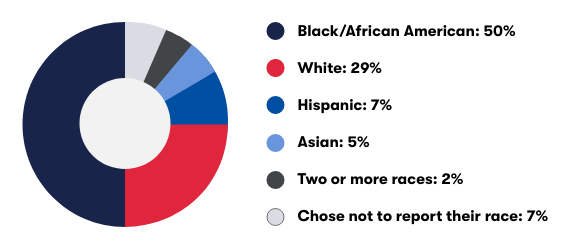
Race and ethnicity
Gender
88%
female
12%
male
Additional demographics
38%
over age 35
10%
military
The self-reported data above reflect enrolled students as of August 2026. The circle graph shows the percentage breakdown of race: 50% Black/African American, 29% white, 7% Hispanic, 5% Asian, 2% two or more races and 7% of students chose not to report their race.
Career Services
Connect your academic work to professional goals through one-on-one coaching, résumé and cover-letter guidance, mock interviews, networking resources, and access to a curated job wall. These services support preparation and career planning; they do not guarantee employment, advancement or a particular salary.
Career Paths and National Occupational Outlook
Knowledge of law and regulation can strengthen work in compliance, contracts, human resources, government, technology, health care and legal support.
Depending on your specialization and prior experience, responsibilities may include reviewing policies, monitoring compliance, supporting investigations, coordinating regulatory responses, managing contracts or explaining legal requirements to operational teams.
NATIONAL CAREER OUTLOOK
| National Occupation | Median Annual Wage | Average Annual Openings | Reference Period |
|---|---|---|---|
Compliance Officers (Financial Corporate Compliance and Compliance Officer) | $80,7304 | About 32,7005 | May 2025 wages; 2025–2035 projections |
Paralegals and Legal Assistants | $62,8906 | About 40,8007 | May 2025 wages; 2025–2035 projections |
Information Security Analysts | $129,1808 | About 14,1009 | May 2025 wages; 2025–2035 projections |
Medical and Health Services Managers (Health Care Administrator) | $123,86010 | About 62,30011 | May 2025 wages; 2025–2035 projections |
Criminal Investigators | $93,79012 | About 7,80013 | May 2025 wages; 2025–2035 projections |
News Analysts, Reporters, and Journalists | $62,20014 | About 3,40015 | May 2025 wages; 2025–2035 projections |
Software Developers (Software Engineer) | $135,98016 | About 95,30017 | May 2025 wages; 2025–2035 projections |
Human Resources Managers | $149,28018 | About 16,80019 | May 2025 wages; 2025–2035 projections |
Chief Executives (Business Executive) | $213,99020 | About 19,10021 | May 2025 wages; 2025–2035 projections |
*The following U.S. Bureau of Labor Statistics figures are not American University graduate outcomes. Wages, openings, and employment growth vary by occupation, location, employer, experience, and economic conditions. The MLS does not guarantee a particular role, promotion, salary, or professional credential.
At AUWCL, We Champion What Matters
Champion What Matters speaks to the passion and principles that guide this law school community. People here stand up for ideas and ideals and truly want to make a difference. We speak up. We act. We champion the rights of musicians through copyright law. We champion health care legislation. We champion human rights around the world. And we champion environmental policy.
MLS vs. JD vs. LLM: Which Degree Fits Your Goals?
American University Washington College of Law offers three distinct credentials for different professional aims. Choose the MLS when you want law-informed skills for a nonlawyer role, the JD when you intend to pursue licensure as an attorney, or the LLM when you already hold a qualifying law degree and want advanced legal study.
DEGREE COMPARISON
| Credential | Designed For | AU Format and Typical Timing | Testing and Professional Pathway |
|---|---|---|---|
Master of Legal Studies (MLS) | Nonlawyer professionals who apply legal and regulatory knowledge at work | Online; full time or part time; as few as 12 months | No GRE or LSAT required; does not qualify graduates to practice law or sit for the bar; coursework does not transfer to the JD |
Juris Doctor (JD) | Students who plan to pursue attorney licensure and represent clients | On-campus; 3 years full time or 4 years part time | LSAT or GRE required for admission; graduates must satisfy jurisdiction-specific bar admission requirements |
Master of Laws (LLM) | Lawyers and other eligible applicants who already hold a JD, LLB, or qualifying law degree | On-campus; usually completed in 1 year | Advanced legal specialization; bar eligibility for foreign-trained lawyers varies by jurisdiction |
Review the full MLS vs. JD comparison for additional program details.

Put Legal Knowledge to Work in Your Career
Build the confidence to interpret legal issues, collaborate across teams, and make informed decisions in regulated environments. Connect with an enrollment specialist for program details or begin your American University online MLS application.
Frequently Asked Questions About the Online MLS
-
A Master of Legal Studies (MLS), also known as a Master of Studies in Law (MSL), is a graduate degree designed for non-lawyers who need to navigate legal frameworks and regulations in their industry without practicing law. Similar non-JD degrees may be labeled Master of Studies in Law (MSL); American University awards the Master of Legal Studies (MLS).
-
No. Neither the LSAT nor the GRE is required to apply to the online MLS. AU instead evaluates your academic record, professional background, goals, and required materials.
-
AU developed the MLS for professionals whose work intersects with laws, contracts, policies, or regulations but who do not plan to practice law. Relevant fields include compliance, human resources, business, government, health care, technology, social work and legal support.
The program may be especially well suited to working professionals who have spent a few years in the workforce after earning a bachelor’s degree and want to build legal knowledge they can apply to their current roles or use to advance their careers. Students who bring professional experience to the classroom may also be able to connect legal concepts more directly to the real-world challenges they encounter in their fields.
-
The key distinction is the professional goal each credential serves. The MLS supports law-adjacent work without leading to attorney licensure; the JD is the professional doctorate for aspiring lawyers; and the LLM offers advanced study to people who already hold a JD, LLB, or another qualifying law degree. The comparison table above summarizes AU-specific formats and timing.
-
The degree can deepen knowledge used in paralegal work, but it is not a paralegal credential or a standard requirement for entry-level roles. AU’s curriculum is broader, covering compliance, contracts, policy, regulation, and other law-adjacent responsibilities.
-
The MLS is not a pathway into AU’s JD. Its coursework does not transfer to the JD program, and the credential does not provide authorization to practice law or sit for a bar exam. Prospective attorneys should review the JD Admission Requirements directly.
-
Yes. Choose a full-time or part-time schedule, during which you’ll complete self-paced coursework, and attend scheduled live classes. Full-time students can finish in as few as 12 months. You should also account for the required three-day immersion in Washington, D.C.
- Admissions and Financial Aid: Our Specialty Rankings. (2026). American University Washington College of Law. Retrieved September 16, 2026. ↩︎
- Admissions and Financial Aid: Our Specialty Rankings. (2026). American University Washington College of Law. Retrieved September 16, 2026. ↩︎
- Admissions and Financial Aid: Our Specialty Rankings. (2026). American University Washington College of Law. Retrieved September 16, 2026. ↩︎
- Occupational Projections and Worker Characteristics. (2026). U.S. Bureau of Labor Statistics. Retrieved September 16, 2026. ↩︎
- Occupational Projections and Worker Characteristics. (2026). U.S. Bureau of Labor Statistics. Retrieved September 16, 2026. ↩︎
- Occupational Projections and Worker Characteristics. (2026). U.S. Bureau of Labor Statistics. Retrieved September 16, 2026. ↩︎
- Occupational Projections and Worker Characteristics. (2026). U.S. Bureau of Labor Statistics. Retrieved September 16, 2026. ↩︎
- Occupational Projections and Worker Characteristics. (2026). U.S. Bureau of Labor Statistics. Retrieved September 16, 2026. ↩︎
- Occupational Projections and Worker Characteristics. (2026). U.S. Bureau of Labor Statistics. Retrieved September 16, 2026. ↩︎
- Occupational Projections and Worker Characteristics. (2026). U.S. Bureau of Labor Statistics. Retrieved September 16, 2026. ↩︎
- Occupational Projections and Worker Characteristics. (2026). U.S. Bureau of Labor Statistics. Retrieved September 16, 2026. ↩︎
- Occupational Projections and Worker Characteristics. (2026). U.S. Bureau of Labor Statistics. Retrieved September 16, 2026. ↩︎
- Occupational Projections and Worker Characteristics. (2026). U.S. Bureau of Labor Statistics. Retrieved September 16, 2026. ↩︎
- Occupational Projections and Worker Characteristics. (2026). U.S. Bureau of Labor Statistics. Retrieved September 16, 2026. ↩︎
- Occupational Projections and Worker Characteristics. (2026). U.S. Bureau of Labor Statistics. Retrieved September 16, 2026. ↩︎
- Occupational Projections and Worker Characteristics. (2026). U.S. Bureau of Labor Statistics. Retrieved September 16, 2026. ↩︎
- Occupational Projections and Worker Characteristics. (2026). U.S. Bureau of Labor Statistics. Retrieved September 16, 2026. ↩︎
- Occupational Projections and Worker Characteristics. (2026). U.S. Bureau of Labor Statistics. Retrieved September 16, 2026. ↩︎
- Occupational Projections and Worker Characteristics. (2026). U.S. Bureau of Labor Statistics. Retrieved September 16, 2026. ↩︎
- Occupational Projections and Worker Characteristics. (2026). U.S. Bureau of Labor Statistics. Retrieved September 16, 2026. ↩︎
- Occupational Projections and Worker Characteristics. (2026). U.S. Bureau of Labor Statistics. Retrieved September 16, 2026. ↩︎